
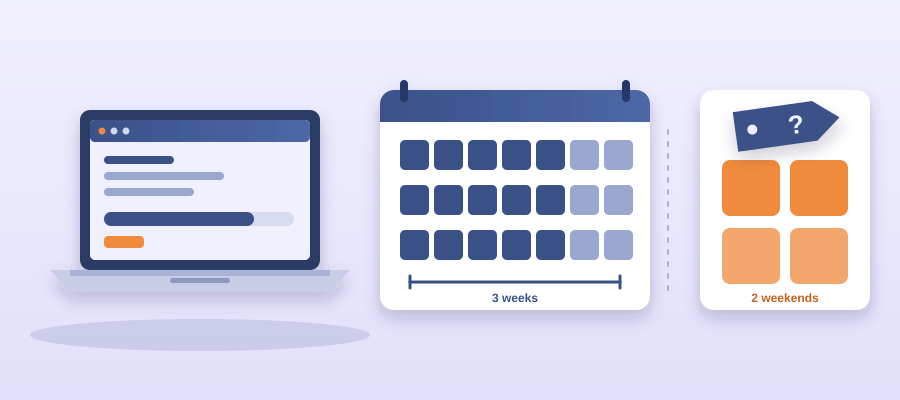
The Two Weekends That Disappear Before Line One
You finish work on Friday with an idea you have carried for months. By Monday you have opened forty tabs of name generators, checked eleven domains, and asked two friends which logo reads better. No line of the business exists yet. You spent the weekend on paint.
The cost is not the weekend itself. The cost is that Monday arrives and you are further from a first customer than you were Friday night. A name does not collect feedback. A domain does not answer a support question. A logo does not show you whether anyone will pay. These are real tasks, but they sit at the end of the queue, not the front.

I know this loop because I ran it. Four products over thirteen years, and the early ones started with weeks of branding before I wrote a line of logic. The later ones started with the structure. The later ones shipped. That is the whole difference I can point to with a straight face.
The fix is not to skip naming. It is to move naming to where it belongs: after the structure shows you what the thing is. Most names get better once you know the product. A placeholder name on day one is not a compromise. It is a decision you are allowed to make later.
What Day One Looks Like When Your AI Worker Opens the Scaffold
On day one you hand your AI worker the 30-day crawl token. It fetches the 206 pages, the 12 module specs, and the 85-file MERN reference codebase straight from the server while you go do your day job. You are not reading a course. You are handing a worker a set of plans that already shipped four times.
The worker copies a structure that exists. Navigation, auth, a pricing layout, an invoicing loop, a customer record. None of it is invented on the day. The worker picks up the same machine that ran Tutoplus in education, BidLight in construction, Tesla DGF inside a 40-engineer company, and Prigmar in AI marketing. Same bones, different skin.

By the end of week one you are not looking at a logo. You are looking at a working scaffold with your placeholder name on it. You can click through the pricing page. You can see where a customer lands after they pay. You can watch the invoice loop fire on a test record. That is what a first week should produce.
The placeholder name does its job here. It labels a thing that already runs. When you sit down on weekend three to pick the real name, you are naming something concrete instead of a feeling. That is a shorter conversation with yourself and a better answer at the end of it.
Week Two Runs the Loops, Not the Branding Deck
Week two is where the scaffold gets wired to your actual skill. Your AI worker takes the module specs and connects the parts that matter for your case: the intake form, the deliverable, the follow-up sequence, the invoice. You are directing. The worker is executing. You bring judgment about what the customer needs. It brings the keystrokes.
This is the part that feels strange the first time. You are not writing code and you are not sitting in meetings. You are reading what the worker produced and telling it what to change. Two short messages can move a week of work forward. That is the shift, and it is the reason three weeks is enough calendar time.

You will still be tempted to stop and name things in week two. Resist it for one more week. The scaffold is revealing the product to you. By Friday of week two you know which module is the actual product and which one is decoration. That knowledge goes into the name and the pricing page on its own.
Week two ends with a system that takes a test customer from first click to paid invoice. Not polished. Not branded. Working. That distinction matters more than any logo you could have drawn in those two lost weekends.
Week Three Is Naming, Pricing, and a Real Customer
Now you name it. You have the product in front of you, so the name is a description task, not a blank page. You pick the domain, you spin up the logo in an hour, and you move on. What took two weekends of anxiety in the old pattern takes an afternoon when there is something real to name.

Week three is also where you set the number. You put a price on the page and you send the link to one real person who has the problem. The invoice goes out from the same loop your AI worker already tested. You watch the first sale land in a system you own, with your name on it.
Here is what is free and what is paid, said plainly. The core kit costs nothing. The 206-page PDF costs nothing. The 30-day crawl token costs nothing. If you want the paid PDF, it is $19 for 21 pages. That is the whole pricing structure. No webinar gate, no upsell ladder.
The point of week three is not a perfect launch. It is a first customer in a system that will still be there next month. The two weekends you did not lose to a name are the reason you got here.
The Real Comparison: What Each Path Leaves You Holding
Path one: two weekends on a name, a domain, and a logo. You end with a brand and no business. You have spent money on a domain and possibly a designer. You have nothing that accepts a payment. The next weekend has to start the real work, and the momentum from the idea is gone.

Path two: three weeks of calendar time with your AI worker on the scaffold. You end with a running structure, a price on the page, one customer, and a name you chose with full information. You spent no money on the core kit. You spent your judgment and your evenings.
The difference is not talent. It is sequence. Naming before building is a guess. Naming after building is a label. The same person with the same idea gets a different outcome because the order changed.
Four products shipped solo is my whole evidence base. I am not going to dress it up as a study. It is what I did, and the later ones started with the structure. That is the pattern I trust.
What You Do Tonight
Pick the placeholder name. Type it into the scaffold and stop thinking about it. Fetch the free kit and let your AI worker read the 206 pages and 85 files while you sleep. Tomorrow you check what it built.

If you want to read the PDF yourself first, that is free too. If you want the 21-page paid version for $19, it is there. Either way, the scaffold is the thing that gets you past the weekends. Name it later. Ship it now.